

test heading

More from the panelists, about what they took away from the conference between Graphic Novels and Video Games (both of which we all agreed, are misnomers). This time, from John Hight of Sony Playstation…
WHAT DID YOU TAKE AWAY FROM THE CONFERENCE?

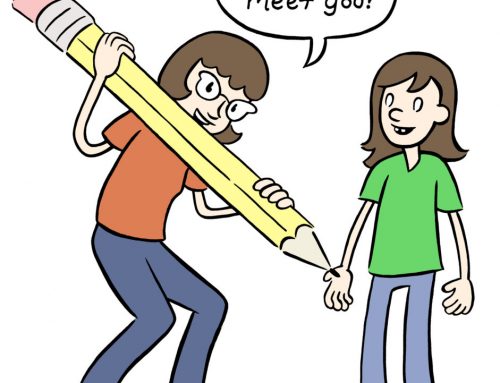
…And point A) may be born out by this Saturday late-night sketch by JESSICA ABEL:

But in all fairness to John Hight, he had a lot more to say. One bit caught me in particular when he wrote:
“Games and graphic novels can take about 2 years to make. Graphic novels are [often] the work of a single author/artist. Games used to be designed by a single person, now they are big budget, big team productions. This makes it hard for games to have a voice and consistent quality.
A graphic novel that sells 15,000 units is successful. A game that sells 200,000 units is a flop.
One possible future for games is to distribute episodic, story-driven content on-line. This might be a way for graphic novelists to reach more people too.”
And right there is something I took away from the whole discussion. I learned that when Derek Kirk Kim serialized his gem SAME DIFFERENCE online, when the last episode posted, he got a million hits.

SERIALIZATION has had a long love affair with comics already, from the very beginning. In the 70’s and 80’s in France, the print magazine (A SUIVRE), the name of which translates to (TO BE CONTINUED) was a phenomenally fertile farmland for many of the greatest European graphic-novel talent. As comics magazines went belly-up one after another, they folded too. But today, with new avenues to release comics episodes — not just online, like the talented bunch on Serializer, but also on other venues, from podcasts to cellphones, to game stations — perhaps something needs to happen again, anew.
To serialize or not to serialize?
Comments and views are most welcome. Especially from readers.
Mark:
I have typed up various musings about serialization in my livejournal over the last year or so. Here are some excerpts:
Why are comics serial at all? Not that it doesn’t work for certain stories (interpersonal soap operas like Love & Rockets or Strangers in Paradise, or flagship superheroes like Spider-Man or Justice League), but there is such a strength in a single-volume, massive book. Blankets, Watchmen and Maus are BOOKS, dammit, and that automatically lends them a maturity and gravitas that feels worlds away from Spider-Man. Some of them originally appeared serially, but they cannot be read except as units. There’s a different kind of strength in a lengthy serialized story that is still a single story – i.e., one that ENDS. Cerebus. The Vertigo trifecta of Sandman, Preacher, and Transmetropolitan.
…I love it when a story ends. It shows responsibility on the part of the writer (and publisher). It allows your story to be a story, complete, whole. It allows it to be analyzed, for God’s sake. Tell us everything, and then we’ll see what it is you said. None of this “maybe you’ll find out next time” crap. It’s so ephemeral. None of that will matter in ten years. I want art that stands as a coherent unit, that can be evaluated as such.
…And yet there’s something to be said for serialization. Would The Lord of the Rings have been better or worse if it had been serialized for worldwide monthly publication? Can you imagine the fanboys? Analyzing every chapter, putting the pieces together about this complex fantasy world, drawing homemade maps, making predictions, taking sides, personally involving themselves in the story. As it is, people still immerse themselves in the world, but the story itself is right there on the shelf. It’s all happened. At the end of chapter thirteen, chapter fourteen is right there waiting. And fifteen, and sixteen, and so on until it’s all over. But then, that’s exactly what serial fiction becomes once it’s finished. Should creators ignore the ephemeral experience, then, either preventing it (by withholding publication until the work is complete, as Frank Miller did with the latest Sin City novel) or seeing it as only a byproduct of practical considerations?
…Some concepts should be serial – concepts that feel timeless, where the overall story doesn’t move very much but maintains the status quo, or where an ending isn’t implied. Invincible, I think, despite its dramatic movement, feels like it could go on forever – the concept is “he’s a young superhero; he fights bad guys,” which is pretty open-ended. Y: The Last Man, in comparison, is definitely moving toward a climax. I look forward to the next issue of both, but I know that Y will eventually be a completed story.
…What effect does the serialized nature of the medium have on serial comic books? Isn’t it fair to say that in a serial artwork, a decent-sized proportion of the experience actually consists of the waiting between installments? Isn’t that where at least some of the magic happens?
…If we try to write more ambitious, long-term stories, how can we still ensure people are hungry for each installment? If we slow down to take the time to make each installment the best it can be (with future generations of readers in mind), does that cheat the fans who’ve been promised a certain schedule?
But then, there’s a certain pride in being a fan “through thick and thin,” and sometimes the long delays can make the final arrival all the more satisfying – I’m thinking things like Kabuki, or Strangers in Paradise, or Bone.
comics on podcasts? can someone elaborate on this for me please?
The only reason I’m at all excited about the new Xbox 360 is the micropayment system in place for the marketplace, where things can be purchased with points (where there’s 80 points to the dollar) like gamer images, in-game items, etc.
While all suppliers have to go through Microsoft, wouldn’t it be great if someone MS seems to respect (McCloud, Woodring) got some sort of online micropayment action going? Certainly the Penny Arcade guys are perfectly placed to make that sort of transition now if they want…
I think one has to consider the different kinds of serialization available: from the classic weekly Sunday pages to the daily strip to the monthly pamphlet to the “whenever I get it done I’ll put out a pamphlet so you may be waiting awhile” (the Seth, Jason Lutes, Gary Spencer Millidge method). The latter method seems to be doing less and less well as those working on comics closer to “novels” realize that an all at once publicatin is better (Carla Speed McNeil finding an alternate in between method that I’m quite enjoying), while the former two methods are readily adaptable to new tech. I think Dave Sim in his consistent monthly production showed that one can keep an audience through serialization, but I don’t think all long narratives lend themselves to such (I remember having a lot of trouble keeping up with Brown’s Louis Riel when it was serialized, but I just read it twice in book form and loved it).
Personally, I’m trying to do a weekly Sunday strip, if nothing else to keep myself moving along at a steady rate.