

test heading
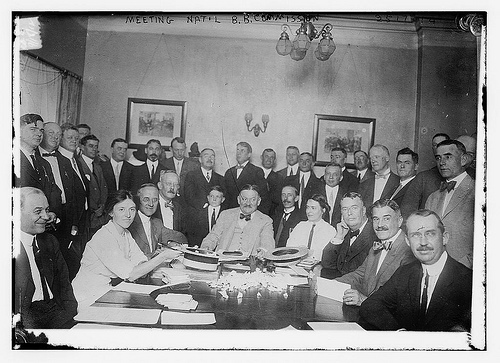
(photo from the Library of Congress. Our meetings have a much higher ratio of women to men. Also no one ever wears bow ties, to our great dismay.)
How do books get acquired at First Second? What will happen to a manuscript after you send it to us?
STEP ONE: Our editor reads the manuscript.
(Please note: manuscript here can mean anything from ‘complete graphic novel that someone sent us’ to ‘two-page summary of a new project from an author we know.’ Things are very variable.)
This step may include: up to six months of the editor not reading the manuscript because there are so many other things to do; an intern reading the manuscript; our temp reading the manuscript; the editor reading the manuscript and then spending two or three or four weeks thinking about the manuscript; the editor re-reading the manuscript and spending yet more time thinking.
If the manuscript succeeds at this stage, it passes to step two.
STEP TWO: Our editor passes the manuscript around to the people at First Second.
Then we all read the manuscript and have opinions, which we discuss.
If the manuscript succeeds at this stage, it passes to step three.
STEP THREE: Our editor talks to our publisher about the manuscript.
‘Hey, I think we’d like to publish this book, it’s for this age group, we’d price it around $X, it’s like these other First Second books that we’ve published or like nothing you’ve ever seen before, here’s where it would fit in the list, it’s extra-super-special-awesome because of ABCZ.’
If the manuscript succeeds at this stage, it moves on to step four.
STEP FOUR: Our editor runs pricing for the manuscript.
So this part is an important thing that we don’t talk all that much about!
Before we decide to publish a book, we try to make sure that it’s going to be a positive financial endeavor for both the creative team and for First Second. Because, you know, we like it when our authors make money, and we also enjoy having money ourselves. (We use it to buy more books with. And the occasional pizza party.)
So we have a form where we put in all the factors: if the book is going to cost $X to print and the author advance is $Y and we project we’ll make $W in foreign sales and the plant (the printing design costs) is $M and the royalties are $Q and we’re going to print N-thousand copies of the book, do we come out with a positive dollar amount?
If the answer is no, the next thing we do is try to change that. Maybe we can spend less money on the printing, or give the author a little lower advance. Maybe there’s some way to make the numbers come out on our side.
But sometimes we can’t! Sometimes we look at our projected sales numbers and say, ‘I don’t know what we could do with this book to make it sell more than N-thousand copies, and if we can’t double that sales number, neither we nor the author will make any money.’
If that’s the case, we won’t publish that book. We’re not going to go into an author relationship with the starting point, ‘we don’t think your book is going to be a success for us.’ Who would want that?
If the manuscript succeeds at this stage, it moves on to stage five.
STEP FIVE: Our editor puts together some paperwork.
There are two documents that need to be assembled before we acquire a book — a finalized version of the pricing document that has all the information from step four, and an acquisition memo.
The acquisition memo basically says, what’s the author’s name, what’s this book called, how much are we paying for it, what has the author written or illustrated before and how much have those books sold, what are some books published in the last few years that are similar to this one and how have they sold?
Everything succeeds at this stage, because we are completely competent at putting together paperwork.
STEP SIX: Our editor talks to the author and/or agent submitting the project.
Before buying a project, it’s good to find out that it hasn’t been sold elsewhere, or that the author has been worried because it took us six months to read her pitch and now she’s permanently run off to the Bahamas in protest. Also it’s good to have a phone conversation to find out if the author is one of those suave, self-assured cartoonists or is someone we’ll have to gradually ease in to talking to people in public.
At this stage, the editor generally also has a conversation about the direction we’re thinking about for the book. If we don’t have a full manuscript, we want to find out what happens at the end! We want to be sure that if we’re thinking the book is for kids in middle-school, there isn’t a robot-alien sex scene scheduled for page 274. And if we’re thinking that some changes may need to be made to the storyline, or the characters, we want to make sure that the author is willing to engage in a discussion with us about that, and to work to find a good resolution.
If the manuscript succeeds at this stage, it moves on to step seven.
STEP SEVEN: Our editor e-mails our Acquisitions Board.
We have Acquisition Meetings every week; they’re on Wednesday afternoons. The people who attend include: us, our parent company’s publisher, our parent company’s parent company’s (MacKids) publisher, and the MacKids sales, marketing, and rights departments.
Before any Acquisition Meeting, all of those people want a chance go take a look at the books that will be presented, so that they have a chance to assemble all the data they need to have a conversation about their thoughts on how the book will work on a sales/marketing/rights level.
So our editor e-mails these people the paperwork created in the previous step, plus some materials about the book — maybe a full manuscript, or the first chapter and some sketches, or a descriptive summary, or etc. And in the body of the e-mail, she writes a paragraph or two about just why the book is so wonderful that we should buy it.
Everything also succeeds at this stage, because we know how to e-mail people. It is one of our super-amazing publishing skills.
STEP EIGHT: Our editor presents the title at our Acquisitions Meeting.
The Acquisition Meetings actually do resemble the meeting in the picture at the top of the post. There are many people, we all assemble around a table. No hats, though! (Alas.)
The editor passes out copies of the paperwork she’s created and talks a little about why she’d like to acquire the book.
The sales people and the publisher comment on the numbers (‘I think we will be able to get this many copies out’ etc.), people discuss their thoughts on whether the project works or doesn’t.
The publisher of Macmillan Children’s has the final word on projects we’re thinking about acquiring, but generally, if the numbers work and the editor says, ‘this is a project I’m enthusiastic about’ in an enthusiastic tone, then we get to buy it.
If the manuscript succeeds at this stage, it moves on to step nine.
STEP NINE: Our editor makes an offer to the agent or author.
Usually there’s a phone call.
Then there is great rejoicing!
(And contract negotiations, which are a story for another day.)
SO HOW/WHERE DO I SUBMIT A MANUSCRIPT FOR REVIEW?
Really great to hear what goes on behind the scenes! I’m a big fan of these kinds of posts — thanks!
Looking forward to that other day!