

test heading
As an offering to our young talent, and to anyone who might find this helpful–here and elsewhere, green or seasoned–I’ve asked a number of experienced authors to send a little word of coaching, encouragement or mentoring to them. We’ll call this new category MENTORS CORNER. It will occasionally feature some authors who aren’t with First Second.
Check back here on Thursdays every week for new offerings. If any of this speaks to you and answers a need or sparks an enquiry, do add your comment–who knows what dialogue may open up from it.
FROM JAMES STURM, of the Center for Creative Studies, and co-author of the upcoming ADVENTURES IN CARTOONING from First Second:
The difference between making a zine or a comic book and a graphic novel is like the difference between a short story and a novel. With a novel it’s a long and sloppy affair and you have to defer that “polishing stage” when everything looks tight. You have to trust that the whole is greater than the sum of its parts. If you don’t you will have a hard time sustaining the energy and commitment to see the project through ’cause it’s a long haul. In other words, you have to believe in the material because you will undoubtedly doubt yourself (sadly, many of us cartoonists feel we are only good as our last drawing).
“FInished panels” makes us feel like we have accomplished something and generate confidence but I find rushing to a finished image when working on a long book is antithetical to building momentum on a long project. With smaller works its easier to proceed through a story with a fair amount of precision. With longer works you have to give the work form and shape with pretty blunt tools before taking out your scalpel (or #2 brush or hunts 102 nib, etc).
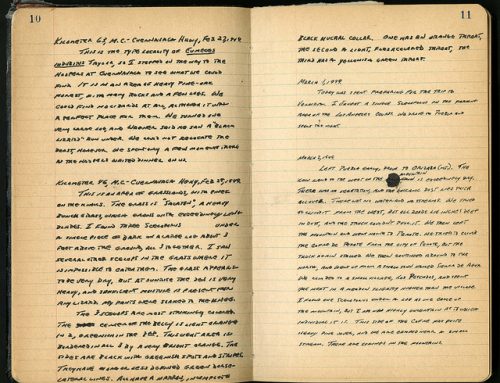
On longer stories, like most novelists, I work in drafts. Each subsequent draft takes longer. The first draft I try to bang out as fast as possible and keep the visual writing as fluid as possible. I am not a big coffee drinker but during this initial draft caffeine really helps! This draft is more scrawled than drawn. Some pages may even be just a few sentences describing what may go where. Some scenes, that are seen more clearly, are more fully visualized. The first draft is usually only readable to me.
The first draft is like building a fence around the project— if I am stuck I just put down anything and move on knowing I will return to it on a subsequent draft. It’s like overseeing a big farm. You can’t afford to dwell too long in one area and allow the rest to go to pot.
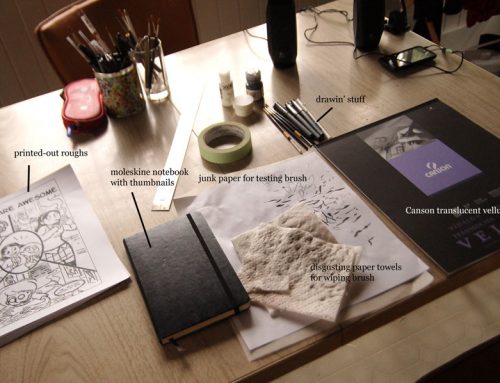
After the first draft I’ll take a few days away the piece than dive back in. The next draft I still work small (thumbnails at half printed page size but in the correct proportions). I go though the book again. I’m amazed by how much easier tackling difficult areas are when I return to something fresh after a short time away from it. This next draft takes at least twice as long as the first draft. My small drawings are tighter. I’m not as concerned with the perfect facial expression (or brush mark since I am still using a pencil) but concentrating instead on panel composition and correct proportions.
The third draft I blow these pages up to the size I’ll be drawing out and pencil out the entire book (always editing and revising as I go). Fourth pass through is inking, but of course returning to the penciled pages, often months later, I’m able to see the pages with fresh eyes and strengthen and clarify the drawing.
I guess the long and short of all this is that by making several passes through a story I never feel too much pressure to ever “get it right” knowing I’ll be returning to each page several times. By the time I am ready to ink I have a lot more confidence than if I would have penciled and inked as I went. Working this way also allows for the inevitable changes in my drawing and helps me maintain greater consistency. Alison Bechedel was telling me how she had to go back a redraw many of the early pages in Fun Home because by the time she was finished her drawing was much tighter and the earlier pages looked shabby (to her eye at least!).
I love this feature. I would really like to see that first stage. Does the script start out all written with no visual accompanyment or is it done half written and half in thumbnails? I saw a Mike Mignola script(for himself) once that was practically just a line of description per panel with very little to go on, and occasionally a little thumbnail of a panel. Just curious. As to the last thing you said:I’m just starting out and because of that fact I notice a marked difference between the quality of the first page to the last. I haven’t established a consistency yet. I read some other advice on this site about the amount you should draw before you even begin a project. Thanks.
This is amazingly good advice and insight into the process, and it relates very strongly with the process of novel writing and the drafting of drafts. One of the best turns you can make as a creator is the one from “having to draft” to “getting to draft”.