

test heading
“Editing” and “Copyediting” are two distinct things, at least as far as the book publishing industry is concerned. Editing is something your editor does, and it generally concerns broad artistic changes like “Let’s make this character a cat instead of a person” or “How about you kill all your characters halfway through and then just have the rest of the book be a lament sung by a greek chorus of cats?” (Note: this is probably bad editing. Except for the parts about cats.)
Editing also touches on the nitty-gritty of language. Word repetitions, run-on sentences, awkward word choices, out-of-character language, reading level issues (for children’s books), etc. But at the end of the day, the editor’s authority extends to matters of taste as well as matters of correctness.
Copyeditors are mostly concerned with correctness. Once your editor has helped you bring your graphic novel into the world, that precious bundle of hopes and dreams is printed out and shipped off to the copyeditor, who is basically the terrifying finishing-school headmistress in this misbegotten childhood metaphor. (Get it? “Misbegotten?”)
The copyeditor uses a standard set of copyediting markups to correct typos, grammatical errors, certain technical infelicities (bad word breaks, etc), factual errors, and continuity errors. The job requires a capacity for intense focus and an ability to keep track of many details. It’s a very hard job, and probably an undervalued one.
Once a book has been marked up by the copyeditor, I take a look at it. (I’m the editor, Calista. Hi!) I go through it, responding to most of the copyeditor’s marks with marks of my own, mostly saying “yes” or “no” (except I say “stet” instead of “no” because I am a fancy publishing person). I also make recommendations and leave queries for the author. Then I ship the whole thing to the author, and they go through it, marking it up with their own yesses, noes, and queries. Then it comes back to me, and I mark it up again, this time with the final word.
Then the designer deciphers it all, and inputs the changes. Let’s take a moment to give thanks for the patience of designers.
At any given moment here at First Second, we have at least a few books in some stage of pre-production editing. (Pre-production editing is the part that comes after a creator finishes their book and before we’re ready to send it to the printer. This can include several passes of copyediting and proofreading and often a certain amount of art correction.)
Right now, we have a bunch of books at varying stages of pre-production, and I thought it might be fun sharing some little examples of typical copyediting issues we handle in graphic novels.
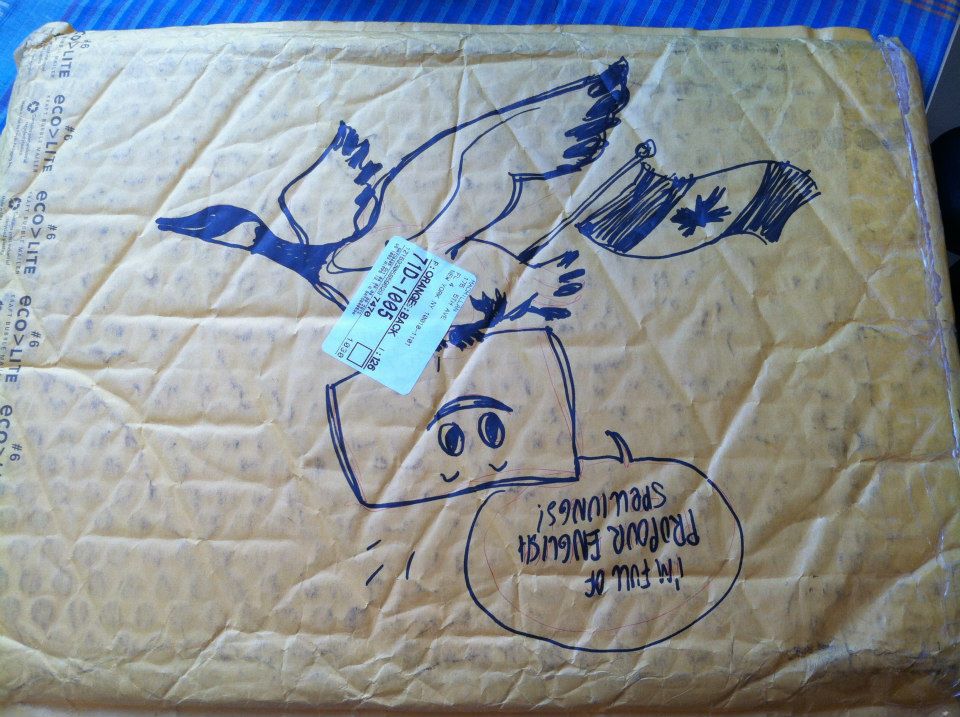
This is the copyedited pass of Delilah Dirk and the Turkish Lieutenant, which author/illustrator Tony Cliff mailed back to me with a funny little illustration on the envelope.
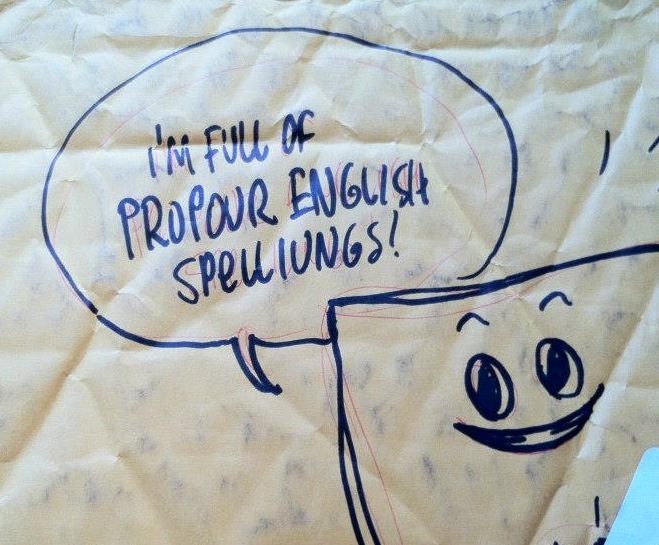
Tony’s Canadian. The copyeditor removed a lot of British/Canadian-style “u”s from his book. You will find no honour in Delilah Dirk now, only honor.
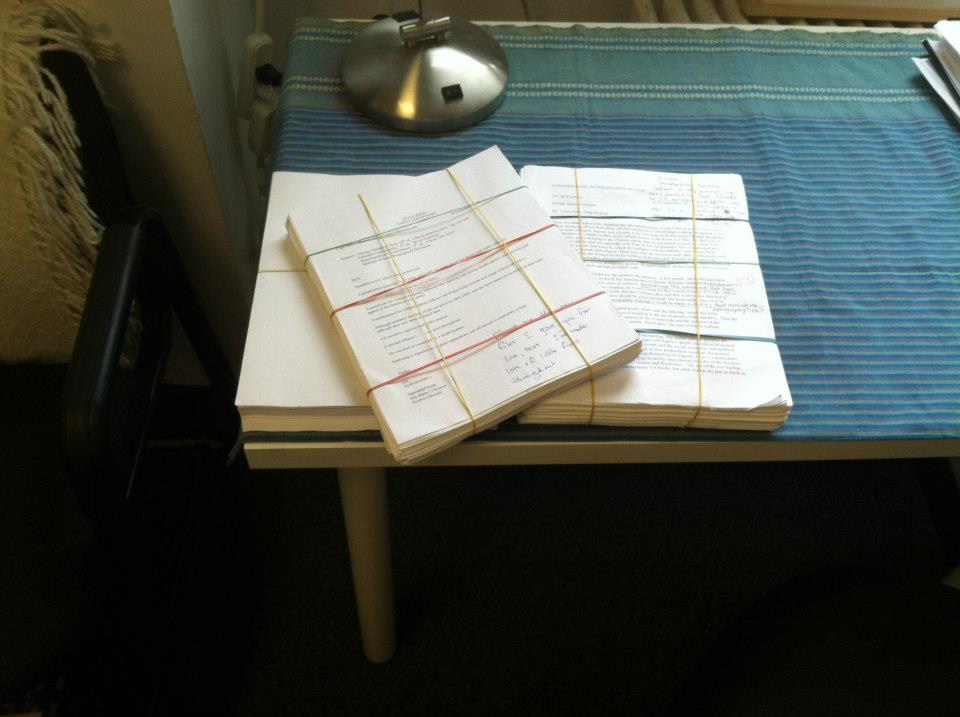
Gene Luen Yang’s next (amazing) book is a double-header — two books that are releasing simultaneously. It’s amazing. Gene, I don’t think you used enough rubber bands.
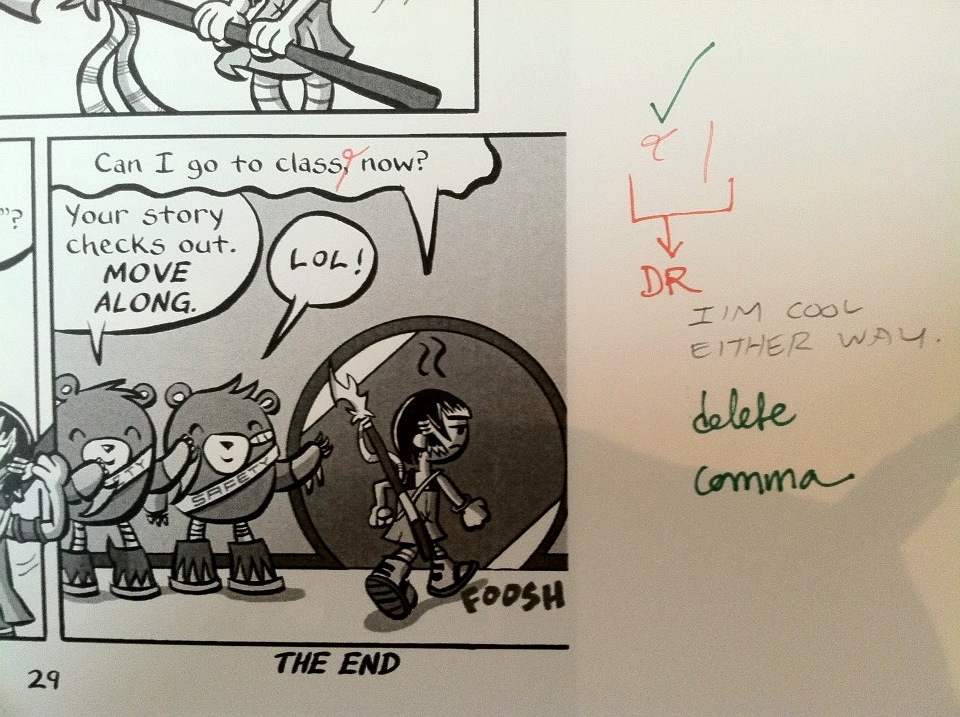
What you’ve got here, in the above photo from Dave Roman’s Astronaut Academy II is really a dialogue.
Copyeditor: Delete this comma! It is incorrect!
Editor: Not sure about this. It’s not technically correct, but the author might have done it deliberately. Dave, what do you want to do here?
Dave: I’m cool either way.
Editor: Okay, then let’s delete it.
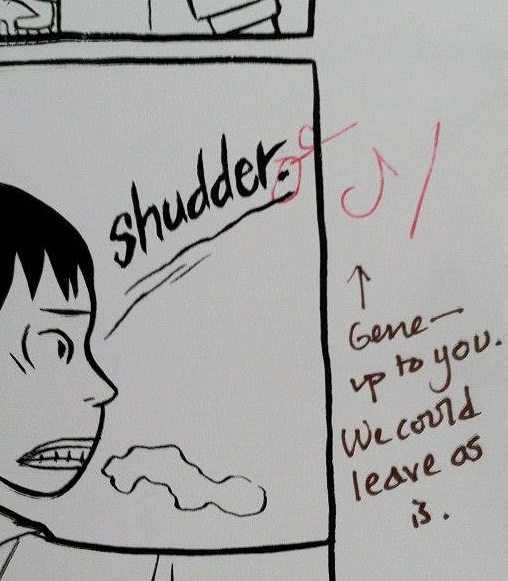
From Gene’s new book. I actually spend a lot of time thinking about punctuation in sound effects. It doesn’t follow the same rules as regular text. In this case, we decided to leave the period there. Do you think we did the right thing?
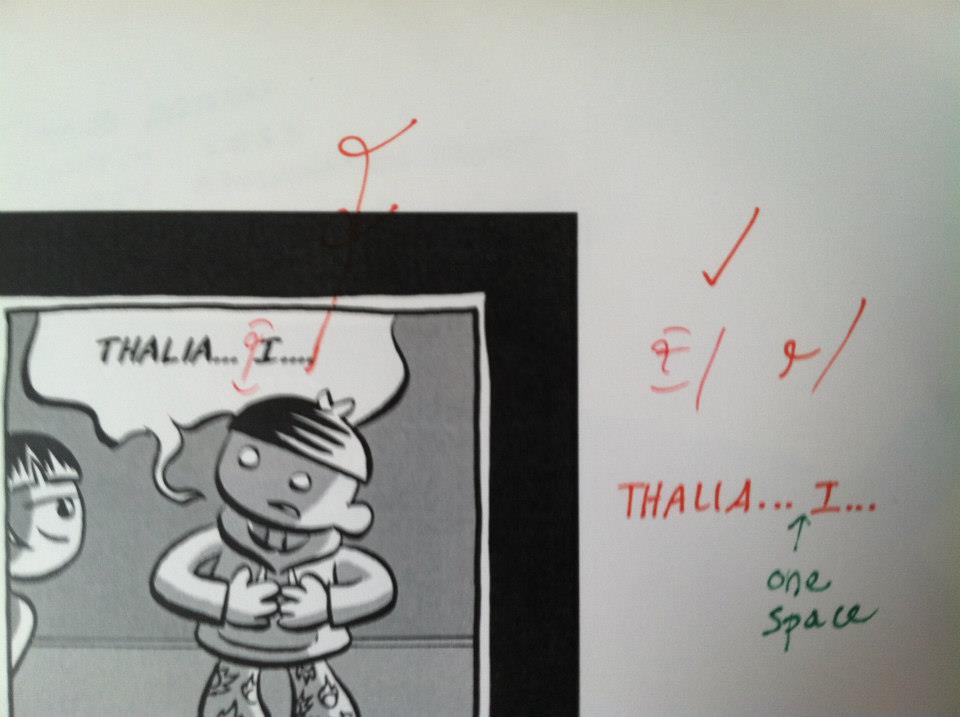
More worrying about punctuation. Ellipses give me no end of trouble.
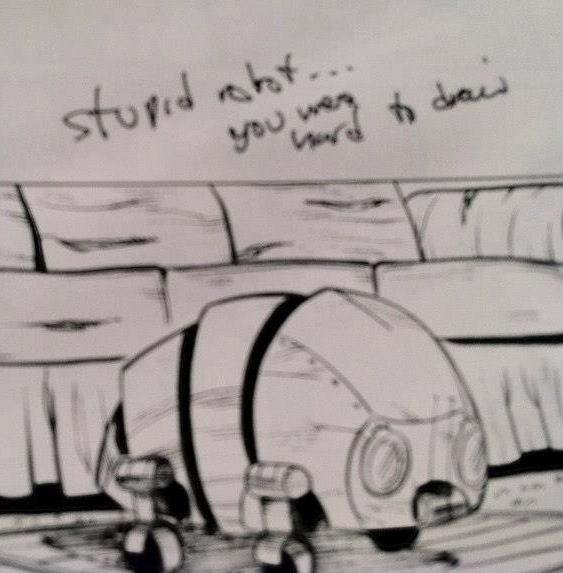
Sometimes authors leave me notes. Faith Hicks wants to make sure we know that this stupid robot was hard to draw. Too bad it’s in, like, four hundred panels in this book. Oops! Sorry, Faith!
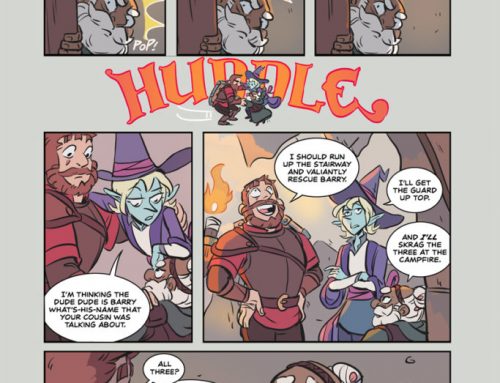
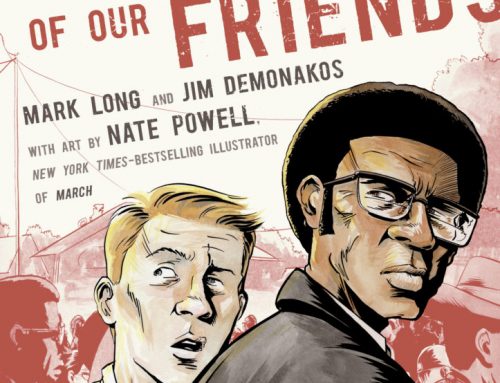
And that was supposed to be sfx, not Sfax. Stupid autocorrect.
Only just noticed now, but that “foosh” Sfax in Dave’s panel might be too close to the crop.
I can’t speak for Canada or the rest of the Commonwealth, but British books published in the US tend to have their spellings Americanised, but American books published in the UK are left alone. Seems like an unneccessary dumbing-down to me. Do the publishers really think Americans will have difficulty with an extra u or an -ise instead of -ize here and there?
I get snotty online lectures from Americans ‘correcting’ my British spellings far more than I used to, these days. I wonder if this publication trend has something to do with it?
This is fascinating. Thanks for this.
I’m a newspaper copy editor in Toronto, so a big part of my job involves tracking down Americanisms and Britishisms in foreign wire copy and Canadianizing them. I often wonder about the editing process for other publishing industries.
It’s interesting that you mention changing Canadian spelling to American. I’m curious: Are there circumstances where you would deem non-American spelling important to the author’s voice, and keep it as is? A notable case study from comics is Jeff Lemire, whose DC/Vertigo work uses American spelling, but whose recent book from Top Shelf, The Underwater Welder — which is set in Nova Scotia — uses Canadian spelling. For a Canadian audience, that can be very important to the authenticity of the work; if you’re reading a book by a Canadian with an openly Canadian setting, it’d be jarring to see “harbour” spelled as “harbor.” By contrast, in the work of Darwyn Cooke — who is Canadian, but whose comics are heavily invested in themes of Americana and 1960s Kennedy-era nostalgia — it makes sense to see his work use American spelling, which it generally does (a notable exception being DC: The New Frontier, which uses American spelling most of the time but has a villain called “the Centre,” spelled the Commonwealth way).
This is delightful! Also, Zack, I just read Broxo for the first time. Gonna have to go back now and start counting canines.
Oh I loved this entry. Even having gone through these processes it’s interesting to see them explained from a step outside.
I remember getting a note about Broxo’s migrating missing teeth which never seemed to be consistent. But we left it since it looked okay visually and I was not excited about performing book-wide cosmetic dentistry on the kid.